Google launched the Data Manager API to general availability on December 9, 2025, and a chunk of the analytics community is reading it as the next stop on the journey toward solving data loss[1, 2]. The framing is understandable — Google has been consolidating measurement APIs for a year, and "fewer endpoints, better data" sounds like progress.
If you're hoping it'll help with ad blockers — or the data loss they cause — it won't.
The Data Manager API is a server-to-server endpoint. The browser hop that blockers actually attack is not in scope — and won't be. This article walks through what the API changes, what it doesn't, and where the browser-side problem still sits.
What changed in twelve months
Three updates, one direction. Server-side.
Data Manager API. Generally available since December 9, 2025. A single endpoint at https://datamanager.googleapis.com/v1/... that consolidates the server-side use of Measurement Protocol, Customer Match upload, Offline Conversions, Enhanced Conversions for Leads, and DV360 audience APIs. Auth is OAuth 2.0 with the datamanager scope — a service-account JWT or refresh token, not a static API secret.
A note on that last point, since it gets misread: when Google's docs say "API secret: not required," they don't mean unauthenticated. They mean OAuth bearer tokens replaced the old static ?api_secret=... query parameter. The auth model is stricter, not laxer. Long-lived credentials can't live in a browser, so this API was never going to be browser-callable.
Customer Match force-migration. On April 1, 2026, the Google Ads API stopped accepting new Customer Match developers. Existing integrations have until March 2027 to move. This is what turned Data Manager API from "recommendation" into "the path." It is also, again, server-to-server.
GTM and Google Tag are merging. Quieter cleanup, but visible in the diagrams Google ships. The three-step Container → Google tag → Ads account model is collapsing into Container → Ads account directly; server-side GTM (sGTM) v3.2.0 in September 2025 stopped loading gtag.js as a separate dependency, and GTM containers are effectively becoming Google Tags.
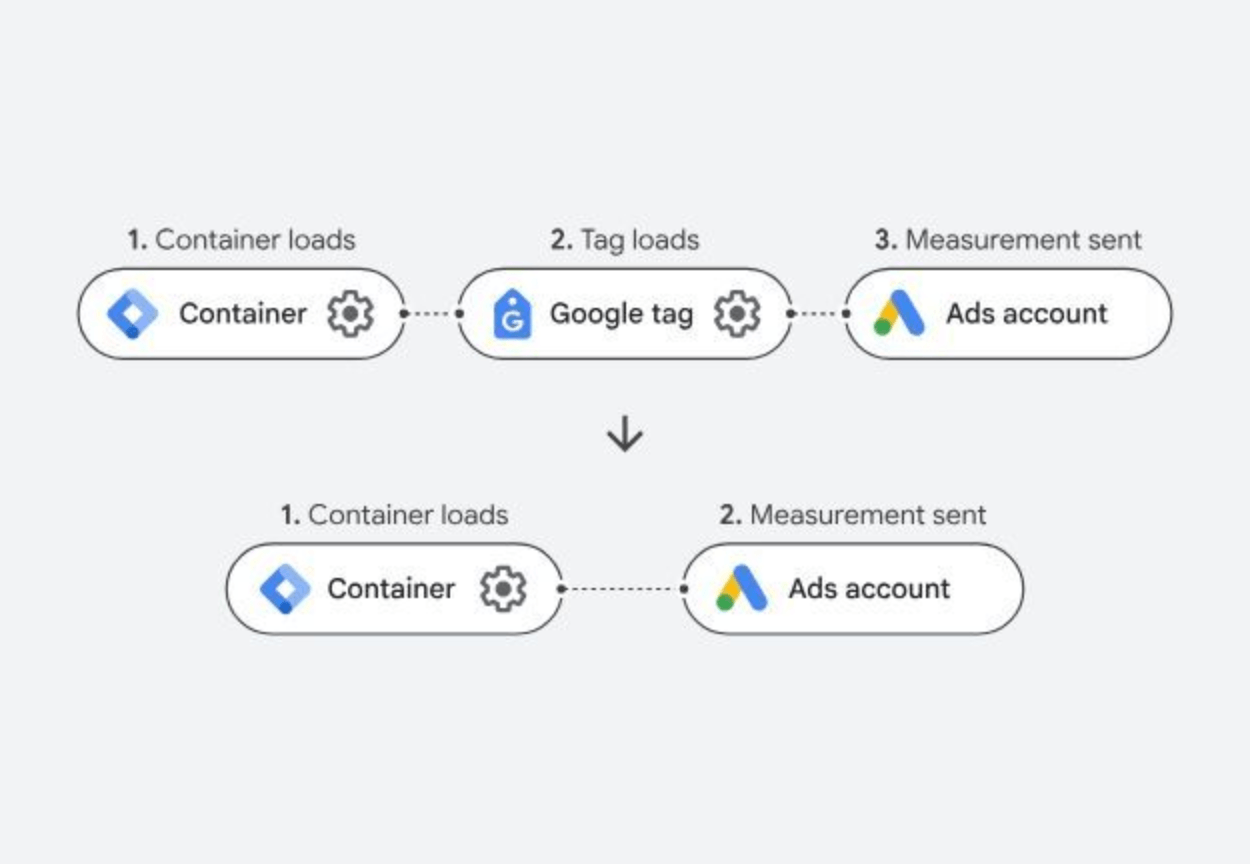
Fewer pieces, fewer dependencies. But every box in the bottom row is still a network request from a browser — and a filter list matches URLs, not architecture diagrams.
Why Data Manager API can't replace browser tracking
Three reasons, none of them subtle:
-
The auth model. Long-lived credentials cannot live in browser JavaScript. Even a short-lived bearer token has to be minted on the server from credentials that never leave the server. By design, this API is not callable from a browser.
-
The scope. Google's own developer documentation frames online conversions through Data Manager as "an additional data source for your tag conversions" — allowlist-gated, with a 14-day trial before the data influences bidding. Augmentation, not replacement.
-
The data still has to come from somewhere. A server-to-server API needs events to forward. If a blocker eats the browser request, the server has nothing in hand. You can't "send better first-party data" if first-party data never arrived.
Tag Gateway is the same problem one layer up
The fair pushback at this point is "but Google does have a browser-side product — Tag Gateway." It's true. Tag Gateway is what First-Party Mode was rebranded to in May 2025, with a Cloudflare one-click integration the same week and a GCP one-click beta since January 2026.
Tag Gateway serves Google's tag scripts and /g/collect requests through a path on your own domain — typically /<u>metrics</u>/.... It does recover some blocker losses today. Honestly: simple-blocker setups stop noticing the request, conversion attribution improves on the margin, and it's worth setting up.
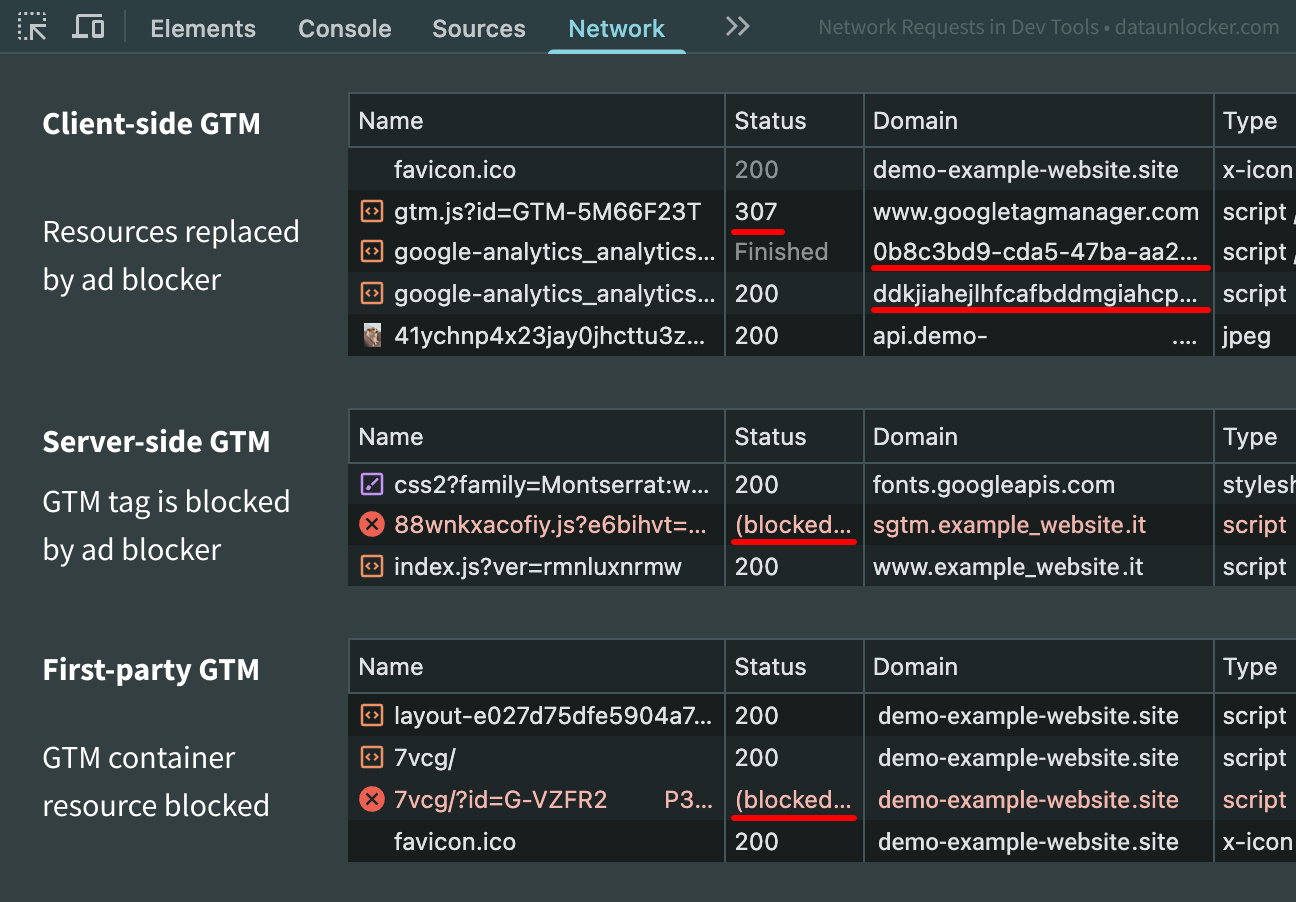
But the per-advertiser path is itself a fingerprint. EasyList's own filter-list policy is to follow domain and path changes when an ad-tech vendor moves them. The prior post here shows first-party-mode requests already being blocked across uBlock, Brave, Ghostery, and AdGuard — same arms race as server-side GTM behind a load balancer, just one layer up.
Tag Gateway is necessary in any modern setup. It is not a permanent answer to filter-list pursuit.
The wider context makes this matter more, not less. Google's Privacy Sandbox — the intended browser-side, privacy-preserving alternative to third-party cookies — was effectively retired in October 2025; only a handful of APIs survive. Server-side consolidation is the only signal-recovery game Google is still playing. Which means the browser → server hop is doing more work than it was a year ago, not less.
Where DataUnlocker fits
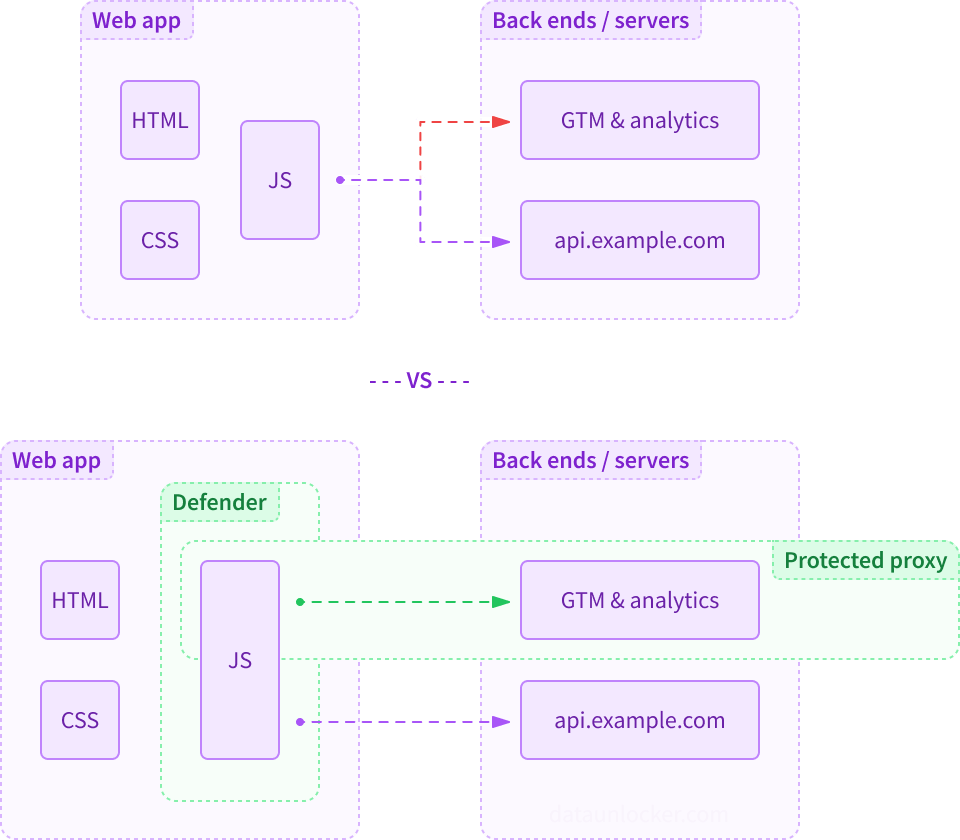
If you already use DataUnlocker, the Data Manager API doesn't change anything about your setup. The two products sit at different layers of the same pipeline:
- DataUnlocker protects the browser → server hop.
- Data Manager API is the server → Google hop.
Both can be in your stack at the same time. Both can keep evolving without disturbing each other. If Google ships another server-side endpoint tomorrow, DataUnlocker still works the same way it does today — that's by design.
For readers who haven't seen DataUnlocker before: it's a cryptographically protected network channel between your web app and its destinations (Google, Facebook, sGTM, anything else). It binds the critical browser APIs — network fetching, element creation, and so on — into that channel. If something tries to tamper with the channel, the web app becomes non-interactive. That's the one outcome ad blockers go out of their way to avoid, which is the whole reason the approach holds up. The prior post on server-side GTM walks through the long-form argument.
In practical terms: it makes browser-side analytics requests reach their destinations even with blockers installed. Across aggregate data from our product, that recovers somewhere between 15% and 50% of analytics events, depending on the niche.
The picture for someone running a modern stack today:
- Browser → first-party server: DataUnlocker keeps the request from being blocked, with no path or domain pattern exposed to filter lists.
- First-party server → Google: Tag Gateway hides Google's hostname; server-side GTM forwards events.
- Server → Google ingestion: Data Manager API receives them via OAuth bearer token.
Three layers, three protections — each covering ground the others can't.
Final thoughts
The honest trade-off, since I've never been able to give one without it: server-side consolidation has real benefits — fewer credentials to rotate, fewer endpoints to keep current, cleaner audit trails. I'd take it. I'm just sceptical that anyone should expect it to help with ad blockers, because the part blockers attack is the part nobody is consolidating, and proxying analytics through a different URL — a popular workaround — sooner or later lands in the filter lists anyway, killing data quality.
If you want server-side ingestion to actually have data to ingest, the first hop has to land. That's what DataUnlocker does. You can add a single page of your website and see the difference for yourself — it's free.